

In coffee, there is no final period. Only an ellipsis. Three dots that signify Continuation, Connection, and Possibility. We are Three Dots Coffee, and our story is not an end point—it is a journey that begins in the deep heart of Southeast Asia and evolves with every relationship we build.
Our Story is Brewing . . . Roasting . . . Processing . . .
A Young Industry, Unlimited Potential: Taking Southeast Asian Coffee to the World Stage
This may be true across many fields, but name recognition and brand value do not necessarily correlate with quality or true capability. Coffee is no exception. The reputation of a farm, a producing country, or a roaster often shapes how we perceive flavor, influencing our taste more than we realize.
It is precisely this gap that Three Dots Coffee, based in Bangkok, Thailand, has focused on—Southeast Asian coffees whose true potential remains underdeveloped due to low visibility and underbuilt industry infrastructure. The company currently concentrates on three countries: Myanmar, where single-estate and micro-lot distribution is still extremely limited; Thailand, where high-quality coffee exists but is largely consumed domestically; and the Philippines, where the history of Arabica production is relatively short.
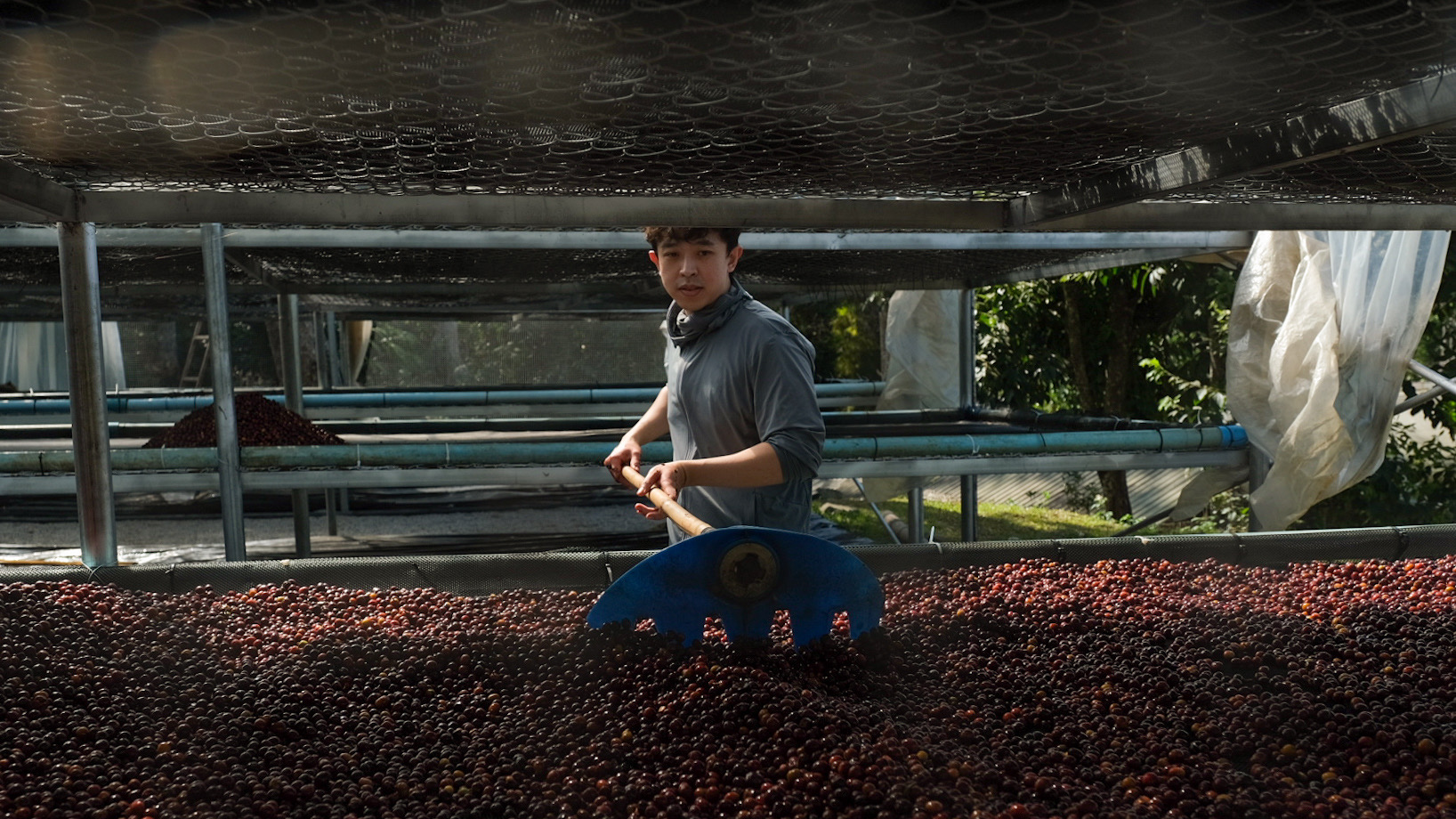
In much of Southeast Asia—excluding Vietnam and Indonesia—the coffee sector is typically characterized by a clear division of roles between traders and producers. In contrast, Three Dots Coffee embeds itself deeply at origin, working hands-on in production sites, engaging directly in processing, and providing technical guidance to farmers. In other words, they operate on a model where “when the company grows, farmers grow with it,” aiming to elevate Southeast Asian coffee to a truly world-class level.
The company was founded in 2025 by three long-time collaborators, each bringing a distinct background and set of strengths. Yar Sin studied medicine at university and, through Biome Coffee, built an extensive network with producers across Myanmar. Kenny spent nearly 15 years overseeing the Thailand market for a tea-based beverage chain operating more than 1,000 stores across five Asian countries. Bix brings over a decade of experience in international marketing at a major Thai beverage manufacturer.
What is the shared vision these three individuals—each with a different path and expertise—seek to realize through Three Dots Coffee?


Growing Together: Farmer Relationships as a Survival Strategy
How deeply a coffee intermediary commits to the production side is often a clear measure of how serious they truly are. Some choose a broker-like position—buying cheaply, selling at a higher price, and profiting from the margin. Others, like Three Dots Coffee, step directly into the processing stage and commit to growing alongside farmers. Both approaches come with advantages and drawbacks, but one thing is certain: without a willingness to shoulder risk, the latter path is not an option.
In reality, for farmers struggling to make ends meet, immediate cash income often holds far more appeal than long-term gains. Who ultimately buys their coffee cherries is rarely their primary concern. With cherry prices currently surging in Thailand, Myanmar, and Laos, it is not uncommon for farmers to sell their harvest to unfamiliar buyers whose intentions and reliability are unclear.

To counter this trend, Three Dots Coffee has introduced a pre-financing system for farmers. They provide deposits before harvest, pay prices aligned with market rates during the harvest period, and guarantee the purchase of the entire crop. Their involvement in technical guidance is not only about quality improvement—it is also a form of self-protection, designed to reduce the risk of losses caused by poor cherry quality.
Bix: “If coffee is cultivated and harvested properly, both yield and quality improve—and that directly leads to higher income. What’s essential is helping farmers understand that structure, so they can truly see the value in investing extra time and effort.
In Thailand especially, there’s a historical context. From the 1960s to the 1970s, the government and the royal projects promoted coffee as an alternative crop for opium poppy farmers. As a result, Catimor—valued for its disease resistance and high productivity—became widely planted. However, that reality no longer aligns with today’s market demands. Farmers now need to make the difficult decision to replant with higher–value varieties such as SL or Geisha. And building trusting relationships with farmers is essential.”


The Advantage of a “Scientific Approach”
Behind Three Dots Coffee’s ability to produce distinctive micro-lots and high-quality specialty coffees lies a deep well of expertise grounded in a scientific approach. Yarsin, currently pursuing Q Processor Level 3 certification, and Kenny, who has already obtained Level 2, are both committed to being able to clearly explain why a coffee tastes the way it does—how sugars are broken down, and what mechanisms shape flavor. With that understanding as a foundation, they focus on developing and applying processing methods that bring out the fullest expression of each coffee’s inherent character.
Kenny: “I studied materials engineering when I was a student, and I’ve always enjoyed approaching things scientifically. Recently, there’s been an increase in so-called shortcut processes designed simply to add flavor to coffee. But that’s not how I think. I want to start from how a process is constructed, how individual components are controlled. I don’t want to settle for assumptions or gut feelings—I want to verify things until they become objective facts. That mindset is something Yarsin and I really share. With him, I feel like we can keep digging deeper in a happily obsessive way without ever getting bored.”

While running both Biome Coffee and Three Dots Coffee, Yarsin is also conducting research in food science at a post-graduate school in Thailand. His network with researchers—many of whom have long been involved in advancing Thailand’s coffee industry, particularly in the northern region around Chiang Rai—has the potential to become a powerful asset going forward.
Yarsin: “Which bacteria or yeasts are active, at what stage, and to what extent—there’s still a lot we can’t see clearly. Much of it remains at the hypothesis stage. In the future, I’d like to build a system that allows us to track the fermentation process with real precision.
When I was studying in the medical faculty at university, I learned that speculation was never acceptable in presentations or Q&A sessions. You couldn’t just repeat information you found online—you always had to base your arguments on published papers. That kind of training is probably the foundation of how I think. And I feel it’s directly feeding into the way I now approach coffee processing, pushing me to take it as far as it can go.”
Such a scientific approach also plays a crucial role in maintaining consistency in quality. Assuming that climate and environmental conditions will change year by year, the team identifies indicators that are effective for each specific season. Increasing the proportion of specialty-oriented coffees through processing—and thereby raising unit prices—also becomes a way to secure farmers’ long-term commitment.

Kenny: “That said, whether we’re setting up a new production line or testing experimental processes, we’re never driven by curiosity alone. We always discuss things through the lens of where the market is heading and what is actually being demanded. Yarsin has a researcher’s mindset, Bix brings deep experience in international business, and I’ve spent years on the front lines of retail, directly sensing shifts in consumer behavior. When the three of us come together, the skill sets needed to move the business forward align in a really effective way.”
Yarsin: “We work along two main axes in processing. One is a classic approach that respects varietals and traditional processing fundamentals. The other adapts to trends, such as fermentations using infusions or selected yeasts. By operating on both fronts, we hope to support the many roasteries and cafés that are seeking differentiation.”
Kenny: “Even within infusion processing, the character of a coffee can change entirely depending on which flavors you choose, how you combine them, and what kind of story you build around them. We want to express originality while respecting the distinctive flavor profiles unique to each country.”


Aiming for Growth Beyond Self-Interest
Yar Sin and Kenny first met in 2024, when Yar Sin was exhibiting at a coffee event to introduce Myanmar coffee to the Southeast Asian market. At the time, Kenny was at a turning point himself—having spent nearly 15 years in the tea industry, he was taking a step beyond it and enrolling in SCA brewing and roasting courses in order to acquire a new skill set in the world of coffee.
Kenny: “I grew a retail chain to more than 100 stores across Thailand. But over time, the market became overcrowded, competition intensified, and I gradually lost the sense that we were truly creating value for society. By the end, I was almost completely burned out. From a store-operator’s position, there was also a constant frustration: we were simply buying raw materials from traders, with very limited ability to control flavor or quality.

Coffee changed that for me. It allows you to be involved from the production process itself, and to feel a much deeper sense of purpose in what you do. In terms of both livelihoods and agricultural techniques, Southeast Asia still lags far behind countries like Brazil and Colombia. In many Thai villages, electricity and running water are not guaranteed, and there are countless children who skip school to work and support their families. If coffee alone can generate sufficient income, living standards can improve—and that, in turn, makes it possible to produce even better coffee. I truly believe there’s hope for creating that kind of positive cycle.”
Although Three Dots Coffee was only founded in 2025, the vision it pursues is an ambitious one. The company is steadily laying the groundwork to elevate Southeast Asia into one of the world’s leading coffee-producing regions—establishing a position comparable to that of Brazil or Colombia. Production is scheduled to begin in Laos and Indonesia next year, and the long-term goal is to build a network of partner processing facilities across Southeast Asia.
Yarsin: “When I attend coffee events, competitions, or auctions, what strikes me most is seeing people genuinely enjoying coffees from every corner of the world—and producers speaking with pride about the coffee of their own countries. Watching that, a natural desire grew in me: one day, I want Myanmar to be part of that landscape as well. I want to help create a future where Myanmar coffee appears on menus and is something people order with trust and confidence.
This isn’t limited to Myanmar. Producers in Thailand and the Philippines are also making serious efforts to raise quality. Since Thailand began hosting the Cup of Excellence in 2023, the overall quality of its coffee has clearly improved. And in the Philippines, the soil conditions and cherry quality I saw were genuinely impressive.”
When Yarsin first visited Mount Apo in the Philippines, natural processing was essentially the only method producers were using. Generally, dry climates and high altitudes are considered ideal conditions for natural processing. In that region, however, sunlight hours were limited, and drying took 40 to 60 days—roughly twice as long as usual.
Yarsin: “When we started experimenting with honey and washed processes, people were surprised, saying, ‘This tastes like coffee from Colombia, Guatemala, or Panama.’ That reaction sparked a movement to create a flavor map for Philippine coffee. Today, even government officials and the Ministry of Agriculture are involved in promoting coffee, and we’re seeing a coordinated effort—across the public and private sectors—to raise quality together.”
Three Dots Coffee is not driven by a model in which only they profit. Their aim is to give back to society and to grow together with the communities they work alongside. One reference point for this philosophy is the approach of a highly respected major beverage company. While the company is not known for flashy advertising, it has a strong reputation for social contribution—being among the first to respond with support during natural disasters, and sponsoring young athletes with exceptional talent, particularly in sports, helping them develop to the point where Olympic medals become a real possibility.
Bix: “My work experience has instilled in me the principle that ‘profits earned through business must always be returned to society,’ a belief upheld for nearly a century that has naturally shaped the way I think. It taught me that business shouldn’t exist only for itself, but should contribute to improving communities and society at large.”
Because the coffee industry in Southeast Asia is still relatively immature, its room for growth is enormous. There’s real potential for it to evolve to a level that stands shoulder to shoulder with well-known origins. I want to witness that potential come into full bloom—not from the sidelines, but as someone directly involved.”


Narratives adapted from https://typica.coffee/en/narratives/producers/three-dots-coffee/
